

Noise at Work Care Plan
And your next actions clear — measured evidence, scheduled follow-through, nothing left to age quietly in a drawer.
An inspector asks for your assessment. What do you actually hand over?
Most sites have a PDF from a surveyor who visited once, years ago. The Care Plan keeps a live, HSE-aligned assessment on file instead.
Four scheduled visits. One fixed price. Never “it’s here somewhere, give me a week.”
What compliance actually requires
Noise at Work compliance isn’t a one-off reading.
The Control of Noise at Work Regulations 2005 set two action values and a limit value. A single site visit tells you where you stood on the day someone turned up with a meter — it doesn’t tell you where you stand today, after a new machine, a reconfigured line, or simply two more years of wear.
How the Care Plan actually runs
Four scheduled visits. Nothing left to chase.
Finding
A site visit measures and maps real exposure, not a guess from a desk.
Action
Each finding becomes a dated, owned action — not a line in a PDF nobody reopens.
Evidence
What you did, and when, is kept on file — retrievable the day an inspector asks.
Review
A scheduled visit checks what changed, so the record stays current, not stale.
Built for your floor, not a generic one
Every sector sounds different. The assessment follows yours.
A grain dryer, a jaw crusher and a generator room all fail compliance in different ways — the Care Plan is built around your real machinery, not a one-size industry average.
80dB(A)
Lower exposure action value
85dB(A)
Upper exposure action value
87dB(A)
Exposure limit value
Care Plan Portal
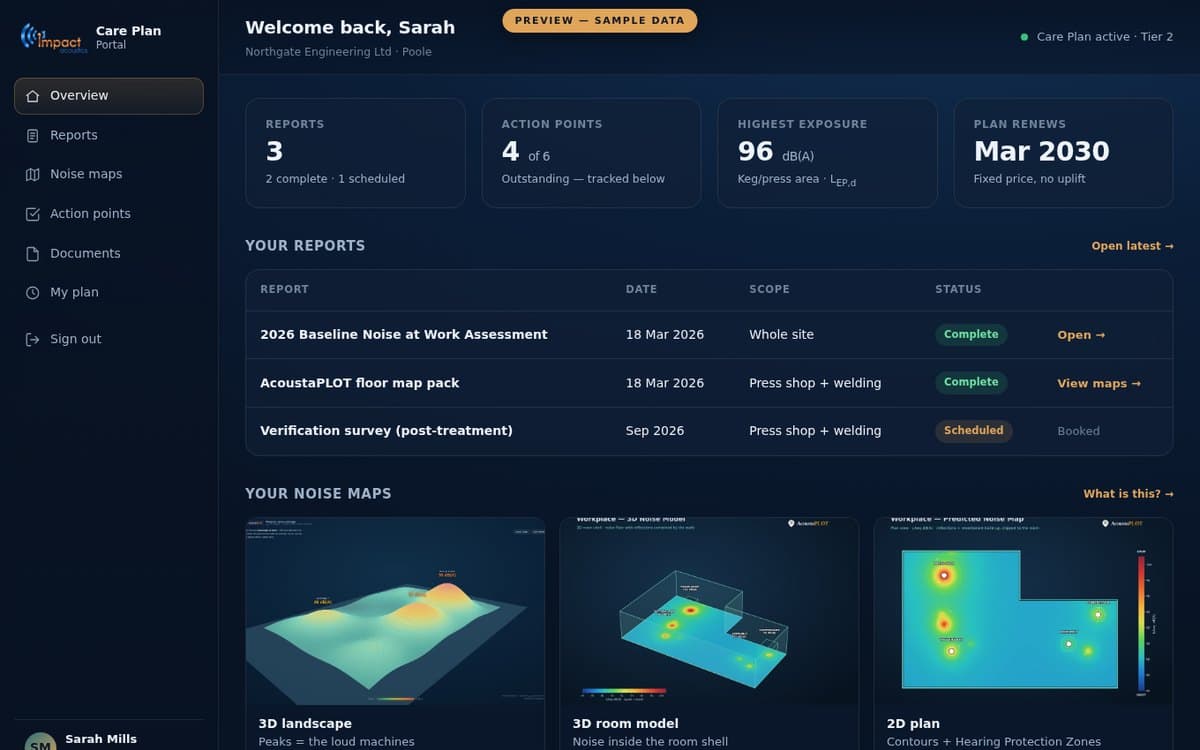
Between visits, your record stays current
Every document, every review date, every change to the floor in one place — so compliance doesn’t quietly expire the moment the surveyor leaves.
Get a priceCare Plan pricing
One fixed price a year. No surprise call-out fees.
A short set of questions about your site picks the right tier — over 25% off the list price on every one of them, for as long as you stay on the plan.
Standard
One building, one shift pattern, a straightforward floor plan.
List £1,200 — you save £305/yr
- Four scheduled visits a year, not a one-off
- HSE-aligned noise risk assessment against the 2005 Regulations
- Care Plan Portal access — documents, review dates, action list
- Dated, owned actions instead of a PDF nobody reopens
Most sites choose this
Extended
Multi-area sites or a more complex floor with several distinct noise sources.
List £1,470 — you save £375/yr
- Four scheduled visits a year, not a one-off
- HSE-aligned noise risk assessment against the 2005 Regulations
- Care Plan Portal access — documents, review dates, action list
- Dated, owned actions instead of a PDF nobody reopens
Large
Larger sites, multiple buildings or shift patterns needing a fuller scope.
List £1,810 — you save £460/yr
- Four scheduled visits a year, not a one-off
- HSE-aligned noise risk assessment against the 2005 Regulations
- Care Plan Portal access — documents, review dates, action list
- Dated, owned actions instead of a PDF nobody reopens
Not sure which tier fits? The instant quote tool asks four questions about your site and picks it for you.
Not a guess
Not a gut feeling. A measured reading, against a published standard.
Every figure on your report is checked against the Control of Noise at Work Regulations 2005’s own 80, 85 and 87 dB(A) thresholds — the same numbers an HSE inspector would check it against, named on the report itself.
The Care Plan
A one-off assessment is a fair start — this is where most people end up
A single assessment is a genuine, standalone option, and it tells you exactly where you stood on the day. What it can’t do is follow your site afterwards — new machinery, a reconfigured line, a longer shift. That’s the honest reason most clients move on to the Care Plan: it keeps the record live between visits instead of leaving it to age quietly.
Noise risk assessment
A proper, HSE-aligned assessment against the Control of Noise at Work Regulations 2005 — 80 and 85 dB(A) action values, 87 dB(A) exposure limit — not a guessed reading from a phone app.
3D Noise Mapper
See exactly where exposure is highest across the real floor plan, so hearing protection and zoning decisions are based on where the noise actually is.
Care Plan Portal
A client portal that tracks where you stand between reassessments, holds your documents, and flags when the next review is due.
Floor mapping report & quote
Get a fixed-price quote for a full floor mapping survey, scoped to room count and tier, delivered straight to the portal.
The numbers, together
Everything above, in one place
Figures quoted elsewhere on this site, gathered here together — not a new claim.
Every sector we cover
Sixteen floors. Sixteen different ways to be too loud.
Each sector page below is built around that floor’s own real machinery — not a generic industry average.
Agriculture
Feeding time in an intensively-housed shed can hit 100 dB(A) or more — HSE's own figure, not an estimate.
See the Agriculture page →Automotive
An impact wrench is loud in short bursts — dozens of times a shift, every bay.
See the Automotive page →Construction
A road breaker striking concrete is one of the loudest moments on any site.
See the Construction page →Engineering & Fabrication
A plasma cutter running a full shift puts real, sustained noise into that bay.
See the Engineering & Fabrication page →Entertainment & Events
Sound engineers, security and bar staff can spend a full shift close to a PA system — and it's their exposure the law actually covers.
See the Entertainment & Events page →Food & Drink
A bottling line runs for hours without stopping — and so does the noise it makes.
See the Food & Drink page →Maintenance Contractors
An angle grinder or air compressor on a maintenance round can run 90–105 dB(A) — noise you carry with you between jobs.
See the Maintenance Contractors page →Manufacturing
A power press stamping metal cycles fast, and the impact noise adds up shift after shift.
See the Manufacturing page →Marine & Shipbuilding
A needle-gun descaler on a hull is loud, sharp, and often worked in a confined space.
See the Marine & Shipbuilding page →Plastics & Moulding
A granulator grinding down plastic is one of the sharpest noise sources on a moulding floor.
See the Plastics & Moulding page →Printing & Packaging
A web press at full speed runs loud for as long as the job takes.
See the Printing & Packaging page →Quarrying & Minerals
A jaw crusher runs loud, continuous, and often for a full shift at a time.
See the Quarrying & Minerals page →Recycling & Waste
A primary shredder tearing through waste is relentless — and so is the noise.
See the Recycling & Waste page →Utilities
Noise-induced hearing loss in utilities workers runs at 25% — higher than any other industry average.
See the Utilities page →Warehousing & Logistics
A baler cycling on the bay is loud in bursts — easy to underestimate across a full shift.
See the Warehousing & Logistics page →Woodworking & Joinery
Circular saws and planer-thicknessers commonly run at 100–103 dB(A) — some of the loudest workplaces we measure.
See the Woodworking & Joinery page →New to the Care Plan?
See exactly what happens at each visit
Four scheduled visits a year, what gets measured at each one, and what you actually receive afterwards — laid out step by step, with no jargon left unexplained.
How it works →Floor Mapping
Need the floor mapped once, not assessed every year?
A one-off product, separate from the Care Plan subscription — a full floor mapping survey of your site, priced by room count and the level of detail you need.
- Standard mapfrom £750+£75 per extra room (3 included)
- Photoreal + interactivefrom £1,050+£110 per extra room
- Photoreal + flythroughfrom £1,350+£150 per extra room
Keep your assessment current.
One site or every site — the first check is always free.
Run the 60-second check